
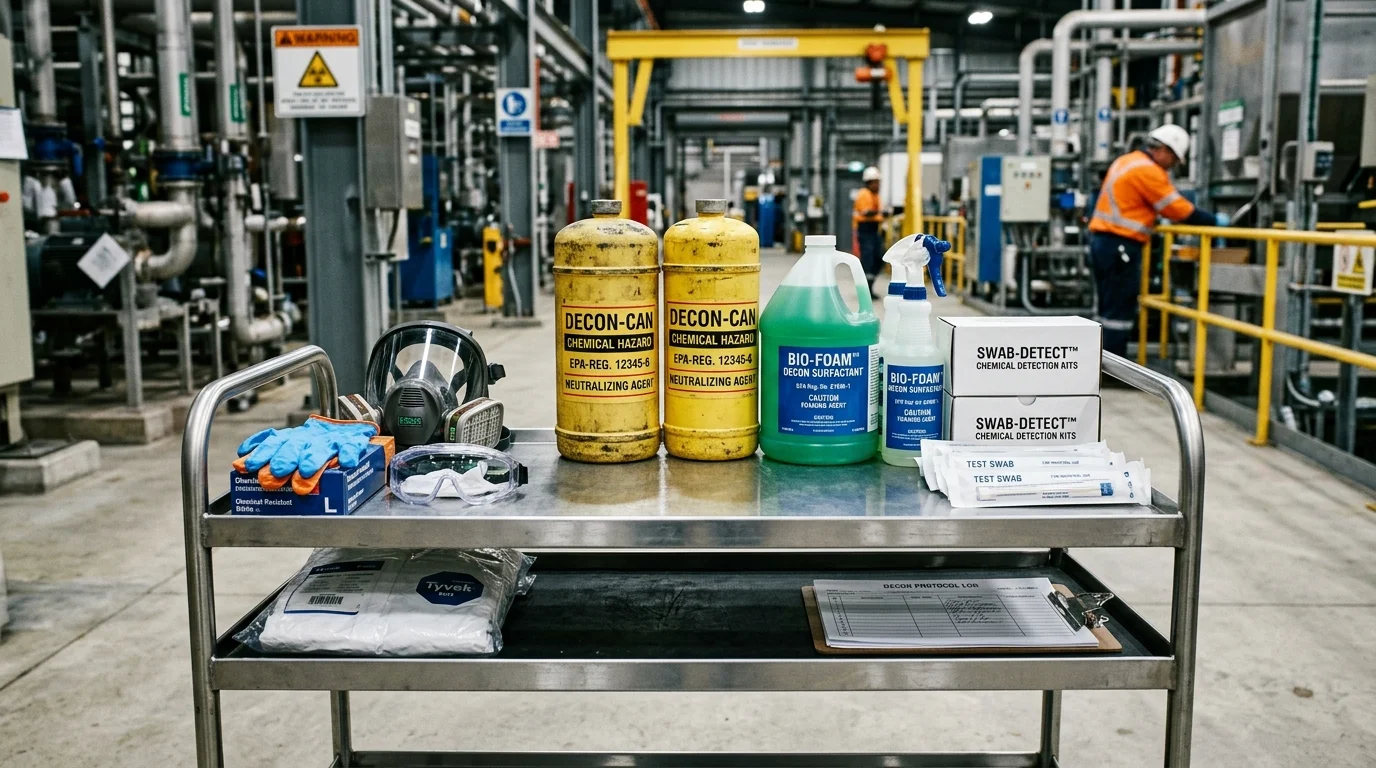
Products Used to Decontaminate a Meth House: Chemicals, Cleaners, and Testing Kits
✨ This article was AI edited. Editorial responsibility: CrownClassicCleaners.net.
Produced with AI. This article was artificially generated. Editorial responsibility: CrownClassicCleaners.net.
To decontaminate a house contaminated with methamphetamine, certified hazmat contractors deploy three specialized product categories: 1) industrial alkaline surfactant emulsifiers (such as Apple Environmental Meth Remover or Crystal Clean) to break down the lipophilic drug resin and MSM cutting agents, 2) binary oxidizing decontamination foams (such as EasyDECON DF-200 or hydrogen peroxide/quaternary ammonium blends) to chemically neutralize the amine drug bonds into non-toxic water-soluble salts, and 3) NIOSH 9111-compliant surface wipe testing kits to verify that surface residues drop below regulatory clearance thresholds (typically 0.1 µg/100 cm²).
Remediating a residential structure contaminated by methamphetamine—whether from clandestine laboratory cooking or chronic smoking—requires far more than conventional janitorial supplies or domestic cleaning sprays. Methamphetamine hydrochloride and its freebase vapors bond tightly with paint binders, drywall paper, concrete, and wooden framing. Attempting to wash these hazardous chemical residues with inappropriate over-the-counter products often spreads the contamination across larger surface areas or produces toxic off-gassing reactions. Understanding the exact chemical formulations, foaming agents, and testing products utilized by certified environmental abatement professionals is essential for achieving legal clearance and restoring occupant safety.
The Chemistry of Abatement: Surfactants vs. Oxidizers
Professional decontamination products function via two complementary chemical mechanisms: mechanical solubilization and chemical degradation:
| Product Category | Representative Formulations | Chemical Mechanism | Primary Application Phase |
|---|---|---|---|
| Alkaline Crystal Cleavers | Apple Environmental Meth Remover, Crystal Clean | High pH (10.5–11.5) surfactant blend emulsifies non-polar drug residues & MSM matrix | Initial mechanical wash; wall, ceiling, and hard floor scrubbing |
| Binary Oxidizing Foams | EasyDECON DF-200, Sandia National Labs MDF-100 | Hydrogen peroxide + quaternary ammonium activator cleaves amine functional groups | Secondary oxidation; high-cling foam applied to vertical walls and structural framing |
| Broad-Spectrum Disinfectants | Benefect Decon 30, Fiberlock ShockWave | Botanical or multi-quat antimicrobial solutions reduce secondary organic odors | Subfloor conditioning and crawlspace odor suppression |
| Polymer Encapsulants | Fiberlock Recon, Zinsser B-I-N Shellac Primer | High-solids resin barrier locks remaining trace sub-threshold molecules | Post-clearance sealing only; NEVER used as a primary cleaning substitute |
| Diagnostic Verification Kits | AccuMeth Rapid Test Kits, NIOSH 9111 Gauze Swabs | Lateral flow immunoassay strips & isopropanol analytical gauze for GC-MS lab testing | Pre-remediation mapping and final post-abatement clearance certification |
Why Common Household Products Fail (and Dangerous Reactions)
Property owners often ask why they cannot simply wash contaminated walls with common retail cleaners. Laboratory and field studies have proven that domestic products are ineffective and potentially dangerous:
- Chlorine Bleach (Sodium Hypochlorite): Bleach is an oxidizer, but it does not break down methamphetamine hydrochloride. Applying bleach to methamphetamine residues creates dangerous chloramine gas emissions while leaving the toxic drug molecules intact on structural surfaces. Lab tests consistently report positive drug readings after bleach cleanings.
- Vinegar (Acetic Acid): As a mild acid, vinegar converts methamphetamine into its highly stable, water-soluble salt form. While it may dissolve superficial dust, it drives the drug salts deeper into the pores of drywall and unsealed plaster.
- Trisodium Phosphate (TSP) Alone: Pure TSP provides high alkalinity that helps lift oils, but it lacks the specialized lipophilic surfactants needed to encapsulate semi-volatile methamphetamine molecules, often smearing the contamination across wider wall sections.
- Ozone Generators: Ozone gas deodorizes rooms by oxidizing volatile organic sulfur compounds (such as those from MSM or cooking odors), giving a false sense of clean air. However, ozone does not neutralize methamphetamine salts bound to drywall or cabinetry.
Detailed Review: Professional Chemical Formulations
1. Apple Environmental Meth Remover
Developed specifically for meth lab remediation contractors, Apple Environmental Meth Remover is a proprietary, non-hazardous liquid surfactant formulation. It does not rely on harsh caustics or heavy acids. Instead, it utilizes specialized micellar surfactants that lower surface tension below 28 dynes/cm, penetrating micro-porous drywall paint to dislodge methamphetamine molecules and suspend them in the wash water for easy towel extraction.
2. EasyDECON DF-200 (Sandia National Laboratories Formulation)
EasyDECON DF-200 is an advanced, military-grade decontamination system originally developed by the U.S. Department of Energy’s Sandia National Laboratories for biological and chemical warfare neutralization. It is a three-part binary formulation consisting of:
- Part A (Surfactant / Quaternary Ammonium Blend): Lifts organic residues and penetrates bio-membranes.
- Part B (Hydrogen Peroxide Oxidizer): Provides rapid oxidative power that cleaves chemical bonds.
- Part C (Diacetin Bleach Activator): Accelerates the oxidation reaction, enabling complete chemical breakdown within a 15-minute dwell time.
When applied through a compressed-air foaming wand, DF-200 produces a thick, shaving-cream-like foam that clings to vertical walls and ceilings without running, ensuring sustained chemical contact time.
Essential Equipment Deployed Alongside Chemicals
Chemical products require specialized delivery and air-handling equipment to prevent worker exposure and property cross-contamination:
- Compressed Air Foamers (Foam-It / Solo Foamers): Generates high-expansion foam that maintains an 8:1 expansion ratio, allowing chemical reagents to dwell on vertical drywall without pooling onto subfloors.
- True-HEPA Air Scrubbers: 500 to 2,000 CFM industrial negative-air machines fitted with multi-stage pre-filters, activated carbon potassium permanganate canisters (for volatile organic chemical vapor adsorption), and certified 99.97% HEPA final filters.
- Microfiber Decontamination Towels: Dense, 300+ GSM microfiber cloths that mechanically trap suspended drug salts during wiping. Contractors utilize color-coded eight-fold wiping techniques to prevent cross-contamination.
- Personal Protective Equipment (PPE): Level C hazmat ensembles including NIOSH-approved full-face elastomeric respirators with combination P100 / Multi-Gas / Organic Vapor / Acid Gas cartridges, DuPont Tychem or Tyvek protective coveralls, and double-layered 8-mil nitrile gloves.
The Step-by-Step Professional Product Application Protocol
Phase 1: Porous Material Removal & HEPA Vacuuming
Before applying liquid chemicals, contractors strip and double-bag all porous materials that cannot be washed (carpets, acoustic ceiling tiles, foam mattresses). Technicians then perform slow, overlapping HEPA vacuuming across all ceilings, walls, subfloors, and framing to remove dry MSM crystalline dust.
Phase 2: Primary Alkaline Surfactant Wash
Contractors dilute Apple Meth Remover or industrial crystal-cutting surfactant in warm water (110°F–120°F). Using the three-bucket system (Cleaning Solution, Waste Rinse Basin, Clean Rinse Water), technicians scrub walls in 3-foot by 3-foot squares using aggressive mechanical agitation, immediately wiping the slurry away with clean microfiber towels.
Phase 3: High-Cling Oxidizing Foaming Treatment
Technicians spray EasyDECON DF-200 across all vertical walls, ceilings, door jambs, and cabinetry interiors. The foam is allowed to dwell for 15 to 20 minutes to chemically cleave remaining trace molecules. Once the reaction completes, surfaces are washed down with clean, warm water and dried with clean lint-free cloths.
Phase 4: Air Scrubbing & Dehumidification
Industrial commercial dehumidifiers and negative-air scrubbers run continuously for 48 hours to eliminate humidity, dry structural drywall, and filter any lingering airborne volatile particulates.
Diagnostic and Post-Clearance Testing Products
The success of the chemical application must be documented through empirical laboratory evidence before a property can be re-occupied:
- AccuMeth On-Site Lateral Flow Test Kits: Field-diagnostic colorimetric cassette kits with built-in 0.1 µg/100 cm² sensitivity cutoffs. Contractors use these rapid test strips to verify that a room is ready for final independent testing.
- NIOSH Method 9111 Wipe Sampling Gauze: High-purity cotton or rayon gauze pads wetted with 2.0 mL of analytical-grade reagent alcohol. Certified industrial hygienists wipe 100 cm² template frames in overlapping S-patterns, deposit the gauze in glass sampling vials, and dispatch them under strict chain-of-custody to an AIHA-accredited laboratory for Gas Chromatography-Mass Spectrometry (GC-MS) analysis.
Frequently Asked Questions
Can a homeowner buy professional meth decontamination chemicals?
While some specialized surfactant products (such as Apple Environmental Meth Remover) are available for commercial and public purchase, high-grade binary foaming systems like EasyDECON DF-200 are generally sold exclusively to certified hazmat remediation contractors who possess OSHA 40-hour HAZWOPER credentials.
How much chemical product is needed for a 1,500 sq ft house?
For an average 1,500 square foot single-family home requiring full wall, ceiling, and flooring decontamination, contractors typically utilize approximately 10 to 15 gallons of concentrated surfactant wash and 20 to 30 gallons of mixed binary oxidizing foam, alongside 150 to 200 dedicated microfiber decontamination towels.
Is painting with shellac or primer acceptable instead of using chemicals?
No. Painting or applying shellac over uncleaned methamphetamine residue is considered an illegal and ineffective shortcut under state health department guidelines. Methamphetamine is semi-volatile and will slowly migrate through layers of oil-based primer and latex paint via diffusion, re-contaminating the indoor air within months. Encapsulation primers are only permitted as a final aesthetic finish after chemical washing has already proven surface levels fall below 0.1 µg/100 cm².
Get our latest guides, news, and insights highlighted in your Google Search & AI Overviews.


