
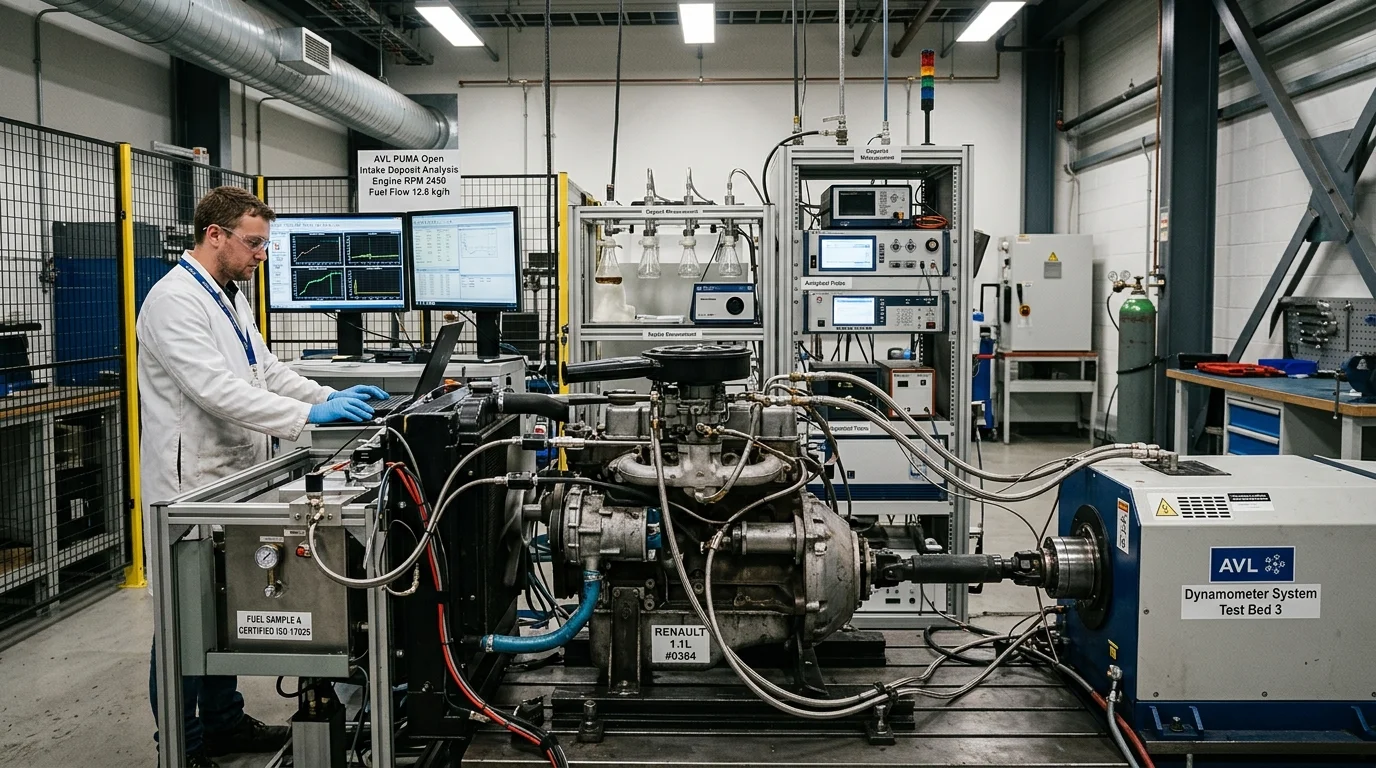
Carburetor Deposits and the R5 Engine Test: CEC Standards & Fuel Additive Ratings
✨ This article was AI edited. Editorial responsibility: CrownClassicCleaners.net.
Produced with AI. This article was artificially generated. Editorial responsibility: CrownClassicCleaners.net.
The Renault 5 (R5) carburetor deposits engine test (standardized under CEC F-03-A-93 and CEC F-04-A-87) is an internationally recognized automotive bench dynamometer testing protocol used by fuel refiners and additive manufacturers to quantify the deposit-forming tendencies of motor gasoline on carburetor throttle bodies, idle orifices, and intake manifolds. Over a continuous multi-hour test cycle on a Renault 1.1L or 1.4L Cléon-Fonte engine, technicians evaluate the efficacy of detergent fuel additives (such as polyetheramine or polyisobutylene amine) in preventing fuel gum accumulation, assigning visual Merit cleanliness ratings from 1 (severe black lacquer obstruction) to 10 (factory clean).
In modern automotive tribology and fuel chemistry, evaluating how gasoline additives prevent engine deposits requires rigorous, standardized, and repeatable laboratory methodologies. Long before fuel injection became universal on passenger automobiles, the Co-ordinating European Council (CEC) established baseline test procedures to benchmark fuel detergent efficacy. Among the most historically significant and technically enduring of these benchmarks is the Renault 5 (R5) Carburettor Cleanliness Engine Test. While contemporary motorists rarely think about the standard CEC procedures running behind their premium pump gasoline, understanding the mechanics of carburetor deposit formation and how the R5 engine test evaluates detergency provides foundational insights into fuel system maintenance, solvent selection, and intake deposit mitigation.
The Physics and Chemistry of Carburetor Deposits
Carburetors operate through the Venturi principle, atomizing liquid fuel into an incoming airstream via localized pressure drops. However, this atomization zone is inherently vulnerable to severe chemical contamination:
| Deposit Zone | Primary Contaminant Sources | Physical Manifestation | Engine Performance Symptoms |
|---|---|---|---|
| Throttle Body & Butterfly Bore | Positive Crankcase Ventilation (PCV) oil mist + airborne dust | Black, oily carbon sludge ring around the throttle plate edge | Sticky throttle pedal, rough fluctuating idle speed |
| Idle Discharge Ports & Pilot Jet | High-boiling petroleum fractions & thermal fuel gum | Hard, amber-colored translucent lacquer or ceramic varnish | Engine stalls at stoplights, lean misfires, hard starting |
| Main Emulsion Tube & Bleed Holes | Oxidized fuel olefins and heavy aromatics | Crusty resin blocking microscopic air bleed orifices | Flat spots upon mid-range acceleration, poor fuel economy |
| Intake Manifold Runners | Blow-by gases, fuel puddle fractionation, EGR exhaust soot | Rough, tar-like carbon deposits on internal runner casting walls | Restricted airflow at wide-open throttle, degraded volumetric efficiency |
During normal driving—especially during cyclic stop-and-go urban commuting—heat soaking after engine shutdown causes lighter fuel fractions in the float bowl and intake throat to boil off. The heavier aromatic hydrocarbons and olefin polymers remain behind, polymerizing under engine heat into stubborn insoluble gums that choke precision airflow passages.
History & Standardization of the CEC R5 Engine Test
To eliminate subjective claims by oil companies regarding fuel detergency, the Co-ordinating European Council formalized the R5 test under two primary test designations:
- CEC F-03-A-93: “Evaluation of the Tendency of Gasoline to Form Deposits in the Carburettor of a Spark Ignition Engine.” This procedure evaluated keep-clean and clean-up performance on throttle body surfaces.
- CEC F-04-A-87: Intake valve and manifold cleanliness assessment using the same operational Renault engine architecture.
The chosen test powerplant was the legendary Renault 1.1-liter (1,108 cc) Cléon-Fonte “Sierra” four-cylinder engine, equipped with a single-barrel Zenith or Solex downdraft carburetor. This engine was specifically chosen by European engineering committees because its compact crankcase ventilation routing and carburetor geometry produced highly sensitive, repeatable deposit formations within a compressed 16-to-24-hour test window.
The Laboratory Engine Test Procedure
1. Engine Preparation & Baseline Calibration
Before initiating a test cycle, the test engine is mounted on a stationary test bed connected to an automated water-brake or eddy-current dynamometer. The carburetor is disassembled, ultrasonically cleaned down to bare metal, and fitted with a brand-new, precision-machined throttle body collar. The engine oil is replaced with standard reference lubricant, and the cooling jacket temperature is set to a strictly regulated 85°C (185°F).
2. The Cyclic Test Duty Schedule
The test engine runs through hundreds of alternating cycles designed to replicate worst-case city driving conditions:
- Phase A (Idle Mode): Engine idles at 800–900 RPM for 3 minutes with minimal throttle opening, maximizing PCV blow-by gas concentration in the intake throat.
- Phase B (Moderate Load Cruise): Engine transitions to 2,500 RPM under 30% dynamometer load for 5 minutes, heating the carburetor body.
- Phase C (High-Load Acceleration): Engine accelerates to 4,000 RPM under 75% load for 2 minutes, testing fuel atomization and shearing.
- Phase D (Hot Soak Shutdown): The ignition is killed for 5 minutes while electric fans are disabled, simulating parking a hot car at a grocery store and allowing residual heat to bake the fuel film onto the throttle bore.
Merit Cleanliness Rating Scale (1 to 10)
At the conclusion of the operational hours, technicians unbolt the carburetor assembly without wiping or disturbing the deposits. The throttle body collar is evaluated in an illuminated optical inspection booth against certified photographic reference standards. The assessment uses a Merit Rating Scale:
| Merit Score | Visual Cleanliness Standard | Fuel Performance Rating |
|---|---|---|
| 10.0 | 100% spotless, bare machined aluminum; zero visible discoloration | Flawless / Theoretical maximum clean |
| 9.5 – 9.0 | Faint straw-yellow haze; zero physical deposit thickness | Top-tier additive package performance |
| 8.0 – 8.5 | Light amber varnish ring along throttle blade perimeter | Acceptable commercial baseline fuel specification |
| 6.0 – 7.5 | Moderate dark brown lacquer coating; slight restriction of idle bypass | Sub-standard detergency; noticeable idle roughness |
| < 5.0 | Heavy black tarry sludge and carbon cake; partial orifice blockage | Severe failure; un-additized base gasoline baseline |
Un-additized base gasoline (fuel containing zero detergents) typically scores between 3.5 and 5.0 Merit on the R5 test, resulting in a thick, sticky ring of varnish that prevents the throttle plate from closing fully. High-quality detergency packages consistently achieve scores of 9.2 to 9.8 Merit, demonstrating complete keep-clean performance.
Detergent Additive Chemistry: Polyisobutylene vs. Polyetheramine
The R5 engine test was instrumental in proving the efficacy of modern deposit control additives (DCAs):
- Polyisobutylene (PIB) Amines: First-generation detergent chemistry widely adopted in the 1970s and 1980s. PIB amines bond with oxidized fuel molecules, keeping them suspended in the fuel stream so they burn cleanly in the combustion chamber rather than precipitating onto carburetor metal. However, PIB additives carry a carrier fluid that can leave slight oily residues on intake valves.
- Polyetheramines (PEA): Second- and third-generation detergents (the active ingredient in products like Chevron Techron, Red Line SI-1, and Sea Foam). PEA molecules possess exceptional thermal stability and nitrogen-rich polar heads that chemically scour cured fuel gums, dissolving existing deposits (clean-up mode) and preventing new formation (keep-clean mode).
Implications for Carburetor Restoration and Maintenance
Understanding the CEC R5 test provides mechanics and equipment restorers with crucial practical principles for real-world maintenance:
- Why Throttle Body Cleaning Restores Smooth Idling: When a vehicle idles roughly, the black ring around the throttle bore is identical to the deposits measured in the R5 test. Removing this ring with high-grade aerosol solvent restores the factory-calibrated air bypass gap.
- Preventing Post-Shutdown Gumming: Because Phase D (hot soak) causes the fastest varnish growth, never store carbureted equipment (lawnmowers, vintage cars, motorcycles) immediately after running them hot. Allow them to idle with cool fuel before storage.
- The Value of Top-Tier Detergent Gasoline: Purchasing gasoline certified under the Top Tier standard ensures the fuel contains detergent concentrations up to 5 times higher than the minimum EPA requirement, actively preventing carburetor deposits during daily operation.
Frequently Asked Questions
Is the Renault 5 engine test still used today?
While the automotive industry has largely transitioned to newer CEC procedures evaluating port fuel injectors (such as CEC F-20-A-98) and direct injection nozzles, the R5 test remains a classic reference standard in tribology literature and is still utilized by chemical companies to evaluate basic carburetor detergency in emerging markets and small-engine applications.
Can fuel additives remove existing carburetor deposits without taking the carb apart?
Fuel additives containing high concentrations of polyetheramine (PEA) can gradually dissolve light to moderate varnish on the throttle plate, intake runner, and main nozzle while the engine is running. However, if an idle pilot jet orifice is already 100% clogged, zero fuel flows through the passage, preventing the additive from reaching the obstruction. In that scenario, physical teardown and manual or ultrasonic cleaning is necessary.
Why did the CEC use a Renault engine instead of an American V8?
The 1.1L Renault Cléon engine had exceptionally tight manufacturing tolerances, low oil volume, and compact intake manifolds that responded quickly to fuel composition changes. American V8 engines of that era had massive intake plenums that buffered deposit formation, making repeatable quantitative measurement far slower and substantially more expensive.
Get our latest guides, news, and insights highlighted in your Google Search & AI Overviews.


